Showing posts with label lectio divina. Show all posts

Monday, March 02, 2026

Seeing God

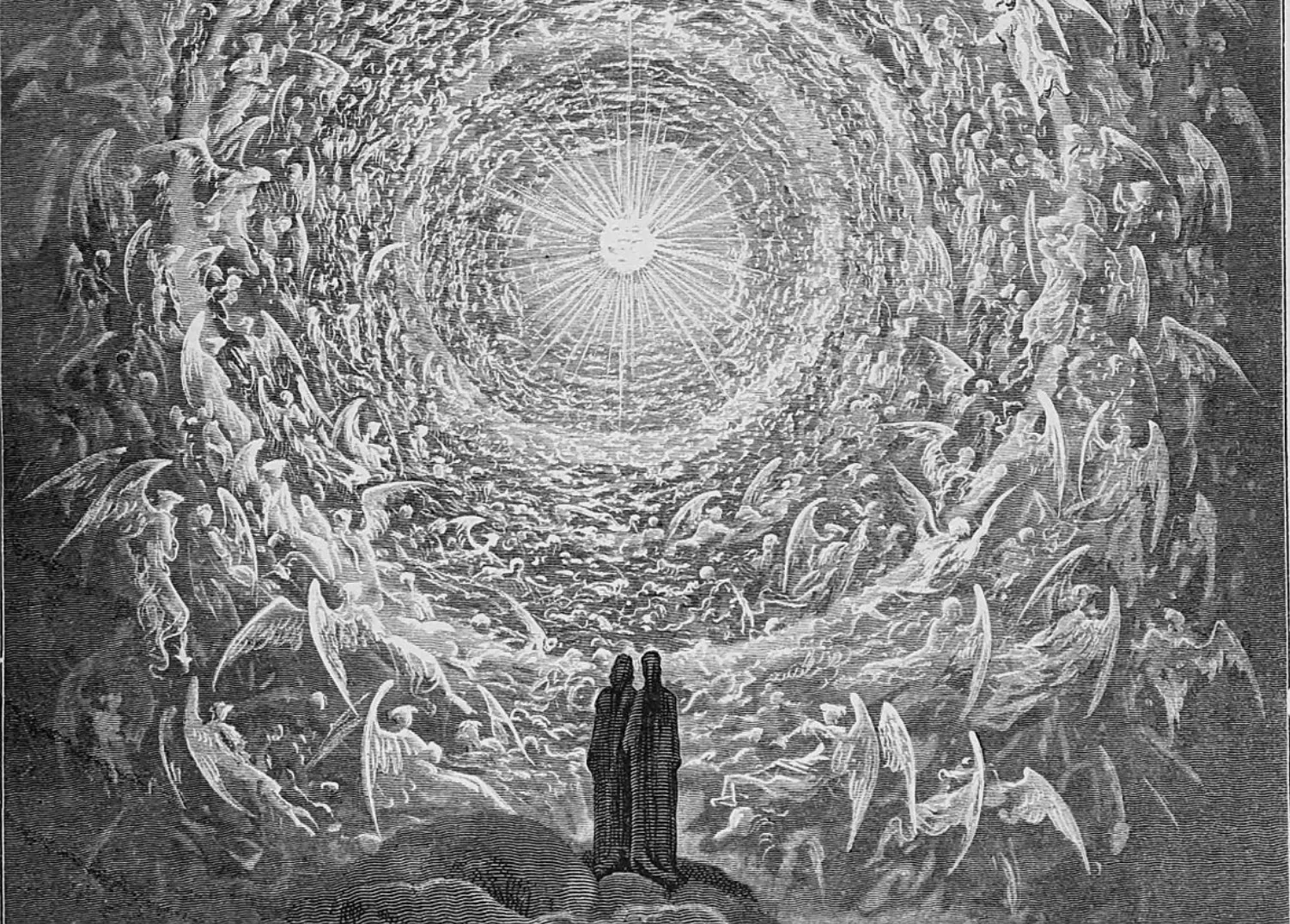
Gustave Dore, ‘Paradiso, Canto 31’ (19th century)
Found here.

The story of Jacob and Esau includes a pericope in which Jacob, having stolen Esau’s birthright, must travel through the country where Esau resides. Jacob frets over the anger his brother feels and seemingly expects retribution. 


As he travels through the country, he sends his wives before him. The first to meet Esau are the women and children Jacob cares for the least. He saves Rachel to the end, but still, he sends her before him with her two children. Then, traveling even further behind Rachel, he meets Esau last. 


When he finally stands before Esau, Esau embraces Jacob. When Jacob is released, he steps back and says, “In seeing you, I see the Face of God.” 


Outside of Jesus, this is the only other person in the Bible who is identified as God and it is because of the mercy and love Esau shows Jacob, despite Jacob’s treachery and scheming. 


The Lenten card asked where I have seen God, and because spring weather brings new life all around, seeing hints of God abound (no charge for the rhyme). Seeing God in people is more difficult, however, because people act horribly. Jacob needed mercy and Esau gave it to him – god-like stuff. According to Jesus, the sick I see in the hospital are God. The prisoner, the poor, the “least of these.” Radical ideas especially in the current social context. 


I’m not good at seeing God in those Christ said are God and yet God, according to this criteria, surrounds me day-in and day-out. I stand on holy ground all the time. May I - may we all - have eyes to see.


3/2/26

Friday, March 29, 2024

Gratitude


art by Sarah Juniper Greene, more of her work here.


One family member with whom I spoke said repeatedly she could not do "X" because it was closed today. Initially, I didn't understand why, and then I remembered it was Good Friday. Even days set aside for "holiness" become mundane if not observed or if no attention is paid to them. And while I doubt the NYSE traders took today to meditate on Christ's sacrifice, having the time set aside reminds some of us to try and take the time to engage in gratitude or reflect in praise.

I've done neither, not for Christ's sacrifice. I engaged in gratitude and reflected in praise as I came home from work, on time and with no lingering items to complete once I arrived home. I took a walk with J in the neighborhood park, naming cardinals and herons, admiring the restructuring of a backyard, staying close lipped around hordes of gnats frolicking in the lengthening light. I flirted with dogs along the path, waved at unknown drivers swinging wide around us, admired the unfurling of the red maple's leaves. 

And maybe coming to some conclusion about the equality of celebrating Christ and celebrating the world for which Christ died is too convenient. But if the world was created by Christ, and Christ came to save/rescue/redeem/resurrect it, maybe enjoying its beauty and finding gratitude for its splendor is as honoring to Christ's sacrifice as honoring Christ's sacrifice specifically.

I think God smiles as we smile, sings as we sing and celebrates as we celebrate, so blessings on Good Friday. May Christ be glorified in all of our gratitude.

PRACTICE

Lectio Divina: Read the following passage through after a few deep breaths and pay attention to any word or phrase which sticks out for you. Read through again and pay attention to anything further you notice about the word/phrase and how it applies to you. Read through again and spend time in prayer with the word/phrase asking God what you need to understand/know/do with the word/phrase (i.e., How might God be guiding you? What needs your further action? Where may your understanding need to be changed or expanded? How may this impact your relationship with someone else?). End with a time of thanksgiving. 

John 3:13-21

13 No one has ascended into heaven except the one who descended from heaven, the Son of Man. 14 And just as Moses lifted up the serpent in the wilderness, so must the Son of Man be lifted up, 15 that whoever believes in him may have eternal life.

16 “For God so loved the world that he gave his only Son, so that everyone who believes in him may not perish but may have eternal life.

17 “Indeed, God did not send the Son into the world to condemn the world but in order that the world might be saved through him. 18 Those who believe in him are not condemned, but those who do not believe are condemned already because they have not believed in the name of the only Son of God.19 And this is the judgment, that the light has come into the world, and people loved darkness rather than light because their deeds were evil. 20 For all who do evil hate the light and do not come to the light, so that their deeds may not be exposed. 21 But those who do what is true come to the light, so that it may be clearly seen that their deeds have been done in God.”

Wednesday, March 27, 2024

The Countdown


Four days and counting until the end of Lent. While I enjoy the challenge of writing daily - about something, anything - I look forward to going back to "only" writing in my 5 year journal and my run-of-the-mill journal. I eschewed posting links to the blog this year, wanting to have freedom from my interior editor or from the performer writing for some audience. Still, I thought writing during Lent without the advertising may produce more candid reflections, which in turn may help me enter into the "spirit of Lent" - walking the desert places of my story, finding the springs, releasing burdens I no longer wished to carry.

I still wrote for an audience, knowing J would read the posts daily. Yet when he became my marketer, I knew I had written more authentically as I cringed during any story he shared about "selling" my blog for the day to some group of friends. In horror, I thought of those who may read and if I wanted people to know all the secrets I put down in html. 

If sitting at the computer at the end of the day has lead me anywhere this Lent, it's helped me recognize the exhaustion I feel at the end of most days - am I really this tired everyday? And if I am - why don't I sleep longer or more? (oh, that's right. . .hot flashes!!!!!! for one) Or why not write earlier? (maybe this is why other writers spend the first half of the day writing, not the last dregs of it) Or how might I change what I do in a day to not come to its end pooped out? Or maybe I need to simply extend myself grace because - excuse me - this is how I am created - I need to rest!

In this regard, I fit right in with the 4 and 5-year-olds: red-faced, tearful, rubbing their eyes - every part of their tiny bodies screaming for sleep - but by golly, they want to stay up to play - enjoying their toys, their families, their friends. 

My play just happens to be staring at a cursor, dipping into my brain's wanderings and beginning to type. And this is the other gift of Lent - realizing what I have *always* known. I love to simply start writing and see what happens. I get a charge from following hunches, one line leading to the next, becoming obvious (usually) with each new phrase. 

But now, I'm tired, and I promised myself I'd try to get to sleep earlier tonight. 

Sleep tight. 

PRACTICE

Lectio Divina: Read the following passage through after a few deep breaths and pay attention to any word or phrase which sticks out for you. Read through again and pay attention to anything further you notice about the word/phrase and how it applies to you. Read through again and spend time in prayer with the word/phrase asking God what you need to understand/know/do with the word/phrase (i.e., How might God be guiding you? What needs your further action? Where may your understanding need to be changed or expanded? How may this impact your relationship with someone else?). End with a time of thanksgiving. 

Matthew 11: 25-30

25 At that time Jesus said, “I thank you, Father, Lord of heaven and earth, because you have hidden these things from the wise and the intelligent and have revealed them to infants; 26 yes, Father, for such was your gracious will. 27 All things have been handed over to me by my Father, and no one knows the Son except the Father, and no one knows the Father except the Son and anyone to whom the Son chooses to reveal him.

28 “Come to me, all you who are weary and are carrying heavy burdens, and I will give you rest. 29 Take my yoke upon you, and learn from me, for I am gentle and humble in heart, and you will find rest for your souls. 30 For my yoke is easy, and my burden is light.”

Tuesday, March 26, 2024

The Face of God

The Veil Nebula: ESA/Hubble & NASA, Z. Levay

My eyes filled with tears walking down the hallway at work. The walls, windows and floors cleaned and polished regularly, important people doing important work with data, science and objectivity. The air of distance stinging the wound of vulnerability, illness, death. I could not greet those passing by, I panicked, felt exposed, ashamed - would I inspire pity if someone saw, derision? Or worst of all, indifference and the awkwardness of emotion when one is trained to set them aside?

I had come into work and considered, as I walked the two blocks to my office, my life within this system. My mind took me to Memphis when chaplaincy opened me to working and walking the hallways of hospitals - 19 years ago come August. I thought of who might have been then, around my age now, and to my surprise, J immediately came to mind. Eighteen and a half years ago, he wasn't quite my current age, but close. His energy and enthusiasm, his love of his work and his peers, his khakis, dress shirt and executive folder - a million images decompressed in a few steps. 

The speed with which time moves set my heart on the precipice - as if a single push might send me sailing into the chasm of eternity - no hope of clawing my way back up - destruction the inevitable ending. With one step, my life with J reached the inevitable fork of parting, and then I HAD TO STOP thinking because I could not have made it up the elevator and into my office, much less completed a workday.

Sometimes the edge of grief draws near, and I don't always understand why. I have been tired, worn down by the responsibilities of the day-to-day. I have wondered how to spend more time with my precious J - to share as much love, laughter, and adventure as possible while we still have bodies willing to do the same. Then to consider how rapidly 19 years go, despite the long days. . .and my eyes filled with tears.

As I wrote this, J came in and gave me tissues, then offered to be near - stepping away as I protested because of my own self-consciousness. I, so timid and sheltering of my raw emotion, and J, so open to it, so loving of me. He is the face of God to me - a sacrament of love - thanks be to God.

PRACTICE

Lectio Divina: Read the following passage through after a few deep breaths and pay attention to any word or phrase which sticks out for you. Read through again and pay attention to anything further you notice about the word/phrase and how it applies to you. Read through again and spend time in prayer with the word/phrase asking God what you need to understand/know/do with the word/phrase (i.e., How might God be guiding you? What needs your further action? Where may your understanding need to be changed or expanded? How may this impact your relationship with someone else?). End with a time of thanksgiving. 

Genesis 33:1-11, NRSV

33 Now Jacob looked up and saw Esau coming, and four hundred men with him. So he divided the children among Leah and Rachel and the two maids.He put the maids with their children in front, then Leah with her children, and Rachel and Joseph last of all. He himself went on ahead of them, bowing himself to the ground seven times, until he came near his brother.

But Esau ran to meet him and embraced him and fell on his neck and kissed him, and they wept. When Esau looked up and saw the women and children, he said, “Who are these with you?” Jacob said, “The children whom God has graciously given your servant.” Then the maids drew near, they and their children, and bowed down; Leah likewise and her children drew near and bowed down; and finally Joseph and Rachel drew near, and they bowed down. Esau said, “What do you mean by all this company that I met?” Jacob answered, “To find favor with my lord.” But Esau said, “I have enough, my brother; keep what you have for yourself.” 10 Jacob said, “No, please; if I find favor with you, then accept my present from my hand, for truly to see your face is like seeing the face of God, since you have received me with such favor. 11 Please accept my gift that is brought to you, because God has dealt graciously with me and because I have everything I want.” So he urged him, and he took it.

Saturday, March 23, 2024

The Playhouse


Image from this article.

If you see two posts for today, I *thought* I had posted yesterday, but J informed me tonight nothing actually posted. Once I finally returned to my computer, the post sat in "draft" status. Turns out my brain really had shut off for the night when I wrote. . .

Tonight, I spent an hour or so at a singer-songwriter event held in an old Christian church. Three performers with vastly different styles sang "in the round" - one belting a tune, then the next, then the next and then they started over again. My jaw kept clinching and each time I encouraged my muscles to relax, they returned to the locked position. I don't know why. 

My musings shift between the thrumming volume, the vibrating vocals, the discomforting position of the artists (perched on a stool under the spotlights, listening to their other two stage-mates plugging away). Maybe the voices straining to create a "rich" sound made my neck tight. My mirror neurons guessing at how much force of will it takes to play an instrument and sing out lines of your soul to a room full of strangers with red ticket drinks in aluminum cans and plastic cups. 

The venue arrested me as well. A beautifully bricked church now a playhouse. Arched windows once opened to the sun, now wooded over; a stage where a pulpit and choir likely sat, set with half walls, fake entrances, make-believe windows. All the light of the sun blocked out, so spot lights and stage lights won't have competition. Raised auditorium seating with chevrons up front replace staid pews of wood and cushion.

Maybe the building grew into what it always was - a place for an audience to ingest a product sold by people playing a role, the message given through imitations of life and illumination. 

A harsh critique? Probably too much so. I don't consider myself cynical, yet those words are from my brain. . . 

I like the idea of a church being a playhouse, as I find God 110% the eponym "Creator," and where creation occurs, play dances in fairy rings and rainbows - tree roots and mycorrhizal fungi dependent on one another for life; rain and sunshine colliding to birth colors. If church is anything, maybe it needs to first seek to be playful - to be like God in the world - creative, surprising, giving. 

As I consider the Holy Week's arrival, I wonder, however briefly, if we have really understood all this time what Christ came to do. If we haven't, I pray we will.


PRACTICE

Lectio Divina: Read the following passage through after a few deep breaths and pay attention to any word or phrase which sticks out for you. Read through again and pay attention to anything further you notice about the word/phrase and how it applies to you. Read through again and spend time in prayer with the word/phrase asking God what you need to understand/know/do with the word/phrase (i.e., How might God be guiding you? What needs your further action? Where may your understanding need to be changed or expanded? How may this impact your relationship with someone else?). End with a time of thanksgiving. 


Luke 18:1-8, NRSV

The Parable of the Widow and the Unjust Judge

18 Then Jesus told them a parable about their need to pray always and not to lose heart. He said, “In a certain city there was a judge who neither feared God nor had respect for people. In that city there was a widow who kept coming to him and saying, ‘Grant me justice against my accuser.’ For a while he refused, but later he said to himself, ‘Though I have no fear of God and no respect for anyone, yet because this widow keeps bothering me, I will grant her justice, so that she may not wear me out by continually coming.’ ” And the Lord said, “Listen to what the unjust judge says. And will not God grant justice to his chosen ones who cry to him day and night? Will he delay long in helping them? I tell you, he will quickly grant justice to them. And yet, when the Son of Man comes, will he find faith on earth?”

Tuesday, March 19, 2024

Facing East


Ukrainian Easter eggs decorated by New York City-based pysanka artist Sofika Zielyk

I really need to find another time of day to write these posts. Most nights, I enter into the blogging space somewhat tired and spent from the adventures of the day. I try grasping all the thoughts which have floated through my mind from the early morning "simple presence," to the drive into work listening to my latest audiobook, to the many interactions with the people in my workspace, to conversations with J, the run as the moon rose, finally settling onto the couch and then. . .this.

The vernal equinox takes place in about 50 minutes according to earthsky.org: the earth spinning and now tilting on its axis, pushing us in the Northern Hemisphere toward earlier mornings and later nights, encouraging growth to sprout from tree limbs and garden patches. It is the moment of *almost* equal day and night with the sun rising due East and setting due West. 

One woman wrote about Persephone as the patron goddess of this cycle of moving from "death" to "life." When I read her post, I remembered a poem I wrote in divinity school for "Pastors, Poets and the Kingdom of God" class. Persephone was the subject and the professor chided me for creating such an abstract poem - but he harped at me often about unvieling myself in some authentic way. He saw the cheery demeanor I used to navigate my world, and he knew no one was "that happy all the time." I was insulted at his reaction to the poem as I quite liked it, but he was spot on about the "gloss of cheer" I wore.

Persephone as an archetype encourages balance, though. Balance between the darling, gleeful rush of crocus, daffodil, redbud, cherry blossom and the flaming maple red and aspen gold of fall. Balance between giving birth and burying detritus  - between the rush of youth and the rhapsody of elders. As the goddess who descends to Hades (and the underworld) taking all the beauty and variety of the world with her, leaving the pall of white to cover the earth - then returns to Olympus  (and her mother) and the bounty of springtime and harvest ensues. 

This is the Earth's cycle, but it is also ours - living on the spectrum of polarities - at times closer to Hades, at others, Olympus. And if we are lucky, we live most of our time near the season which pleases us most. Which brings us back to Ecclesiastes and a "time for every season." 

I, for one, am glad it's spring.

PRACTICE

Lectio Divina: Read the following passage through after a few deep breaths and pay attention to any word or phrase which sticks out for you. Read through again and pay attention to anything further you notice about the word/phrase and how it applies to you. Read through again and spend time in prayer with the word/phrase asking God what you need to understand/know/do with the word/phrase (i.e., How might God be guiding you? What needs your further action? Where may your understanding need to be changed or expanded? How may this impact your relationship with someone else?). End with a time of thanksgiving. 

Ecclesiastes 3:18-22, NIV

18 I also said to myself, “As for humans, God tests them so that they may see that they are like the animals. 19 Surely the fate of human beings is like that of the animals; the same fate awaits them both: As one dies, so dies the other. All have the same breath[c]; humans have no advantage over animals. Everything is meaningless. 20 All go to the same place; all come from dust, and to dust all return. 21 Who knows if the human spirit rises upward and if the spirit of the animal goes down into the earth?”

22 So I saw that there is nothing better for a person than to enjoy their work,because that is their lot. For who can bring them to see what will happen after them?

Monday, March 18, 2024

Facing West

Photo credit here.

The late afternoon mixed spring skies with winter winds. I considered walking from my hotel to the nearby shopping area, but thought better of it the longer I stood in the wind unpacking the car.  From my room's windows, gazebos frame the pool and a man-made lake lies just beyond, then houses beyond the lake. Ducks and geese floated atop the lake, and eventually, a young teenager explored the water's edge from his backyard. 

I grew reflective as the setting sun turns the sky butter yellow and sweet potato orange; as blushes of pink flush the clouds and shadows lengthen. Maybe the ending of a day of work gives my mind time to relax or maybe my soul grieves one more day gone or maybe the shock of color ignites my right brain, but I wondered, for the millionth (billionth?) time of my life if I am living the life I want to live. I used to say "the life I am supposed to be living," and in doing so, placed inappropriate amounts of stress on myself and those who dealt with my worried chattering about "how does one know they are on the 'right' path"? 

Often the worry mixed in the God component - was I praying the right way? asking the right question? getting still enough, for long enough, to hear enough of God? The consternation grew from the belief God had "A" plan (i.e. "ONE" plan) for my life, and it was up to me to find it. My current conundrum mirrors the solitariness of my youth - as if there is one way to live my life congruent with my life's ethos, pathos, and logos. I also maintain some implicit understanding that I must work (often hard) to figure out HOW to live life the way I "want" to live it. 

And when I say "life I want," I'm meaning living a life with enjoyable and fulfilling work, while being able to provide for my family, while also having time to be with J, my Dad, our families, the dog; to engage in dance and music; to enjoy art; to travel; to plant gardens; to bake; to create.

Someone shared a story from Barbara Brown Taylor not too long ago. BBT was trying to decide between two good offers for work (I think), and she spent a good amount of time praying to God, asking for direction about which way was the "right" way. Eventually, she felt she heard God say, "Pick one." 

Before I engaged in my last educational adventure, I sensed God saying something similar. Out of centering prayer, I recognized God to be an ever present companion, sanctifying life by being present in it. I could take action or not; choose to go in a direction which appealed to me or another, equally appealing direction. Any choice could be "God's choice" because God is here, with us.

Because I am a wandering soul, my perpetual question will likely be, "Is this the life I want to live? Or is there something else?" I suppose if the question comes up at all, the answer is likely "No, this is not the life you want to live. If it was, you wouldn't need to ask the question in the first place." 


PRACTICE

Lectio Divina: Read the following passage through after a few deep breaths and pay attention to any word or phrase which sticks out for you. Read through again and pay attention to anything further you notice about the word/phrase and how it applies to you. Read through again and spend time in prayer with the word/phrase asking God what you need to understand/know/do with the word/phrase (i.e., How might God be guiding you? What needs your further action? Where may your understanding need to be changed or expanded? How may this impact your relationship with someone else?). End with a time of thanksgiving. 

Psalm 103: 8-18

The Lord is merciful and gracious,
    slow to anger and abounding in steadfast love.
He will not always accuse,
    nor will he keep his anger forever.
10 He does not deal with us according to our sins
    nor repay us according to our iniquities.
11 For as the heavens are high above the earth,
    so great is his steadfast love toward those who fear him;
12 as far as the east is from the west,
    so far he removes our transgressions from us.
13 As a father has compassion for his children,
    so the Lord has compassion for those who fear him.
14 For he knows how we were made;
    he remembers that we are dust.

15 As for mortals, their days are like grass;
    they flourish like a flower of the field;
16 for the wind passes over it, and it is gone,
    and its place knows it no more.
17 But the steadfast love of the Lord is from everlasting to everlasting
    on those who fear him,
    and his righteousness to children’s children,
18 to those who keep his covenant
    and remember to do his commandments.

Saturday, March 16, 2024

Feeling the Edge


I spent time with a college friend tonight catching up on threads of our lives we have not had opportunity to discuss since the beginning of the year. We talked about family, jobs, pets - the thorny problems, the unexpected pleasures and the confounding issues with childhood onset which ebb and flow in intensity. Neither of us sense we have the time to do all we want or need to do, and depending on the day, the fact proves defeating or simply inevitable. 

Boundaries (maybe limitations?) give me an opportunity for choice, though. If I encounter them reflectively, they encourage me to spend time doing what matters to me. If I find I cannot choose to do what matters to me, I again have a choice: take steps to get into a position to "choose my own adventure" or adjust what I can to incorporate more of what matters to me (what gives me life, if you will). 

A gift and frustration of middle age is the recognition of more limits, more boundaries - but maybe this means more choices, a narrowing of focus, a purifying of my goals. The problem remains my deep enjoyment of wanting to do everything. My more practical side tells me I can't do everything, but even considering all the possibilities enthralls me and juices the battery. I think it's genetic. 

Seemingly, I have a great uncle who spent his days in elementary school, atlas opened in his lap, pointing to all the places on its pages saying, "I want to go there and there and there." The story goes he had sailed the seven seas before his 20th birthday - he had explored the world as he wanted. I don't know, of course, if the other 40+ years of his life felt complete or fulfilling, but I imagine the desire to wander never left. I'm projecting, of course, because I'm guessing the wanderlust won't leave me. . . 

But the energy of youth will leave, and has to some degree - a boundary. 

Psychology says children with boundaries grow up to be more confident adults. Something about playing within a strong framework reinforces a sense of safety, maybe even a sense of mastery. Then as the child grows and boundaries broaden, the child masters more and more of his/her world finding a safe place to experiment within the limitations provided. 

We need limitations, it seems, in every phase of life.

Maybe Lent is a time of living into the limitations, giving us freedom to make mistakes within the loving boundaries God provides, but also allowing the limitations to help us discover what we need to release because we simply don't have room or time for it anymore as well as to help us choose what brings us to life.

PRACTICE

Lectio Divina: Read the following passage through after a few deep breaths and pay attention to any word or phrase which sticks out for you. Read through again and pay attention to anything further you notice about the word/phrase and how it applies to you. Read through again and spend time in prayer with the word/phrase asking God what you need to understand/know/do with the word/phrase (i.e., How might God be guiding you? What needs your further action? Where may your understanding need to be changed or expanded? How may this impact your relationship with someone else?). End with a time of thanksgiving. 

Psalm 16: 5-11, NRSV

The Lord is my chosen portion and my cup;
    you hold my lot.
The boundary lines have fallen for me in pleasant places;
    I have a goodly heritage.

I bless the Lord, who gives me counsel;
    in the night also my heart instructs me.
I keep the Lord always before me;
    because he is at my right hand, I shall not be moved.

Therefore my heart is glad, and my soul rejoices;
    my body also rests secure.
10 For you do not give me up to Sheol
    or let your faithful one see the Pit.

11 You show me the path of life.
    In your presence there is fullness of joy;
    in your right hand are pleasures forevermore.

Photo credits: Found on this site.

Friday, March 15, 2024

Listening

Photo credit: here.


I listened to birds squawk today, and as I listened I thought, "God even calls this 'good'." The cawing of sea gulls - "good." The cackle of crows - "good." The aggressive nature of cow birds - "good." The idea can expand, of course, to any and all parts of creation I, or anyone else, calls suspect, apprehensible, a nuisance: mosquitoes, raccoons, chipmunks, pythons, coyotes, deer, brown recluses, sharks, jellyfish - the list could be quite long. This goes for places, peoples, political regimes, cultures (micro and macro). God called it all, all of us, "good," if you take the first creation story at face value. I have a hard time accepting this, however, when the 4th welp rises from my skin within moments of venturing outside, or when my brother displays his penchant for desecrating his life. 

Of course it's not my issue, except if I come down with denque fever (a growing outbreak of the mosquito born virus is happening in Brazil right now); or a python swallows my dog; or the intoxicated man kills my daughter via vehicular homicide - then what do I do? How do I call the creation "good"? What theological gymnastics do I perform to make the equation creation = good actually work out? 

The only way I can (and get ready to roll your eyes) is creation + God = good. Because the only entity who is good is God, and God in us creates what good bits exist. As an old pastor of mine used to say, "We are shot through with sin, but we are justified through Christ: Just as if I'd done nothing wrong. Just as if I'd done everything right." How this applies to mosquitos, I'm not sure, but Paul talks about all of creation and birth pangs as we all move from our current state to our eschatologically complete one.

Maybe one day mosquitos will impart anti-aging serum into my resurrected body with each bite while the lion lays down with the lamb.

My other bird related musing came when I witnessed a sparrow feast on the fern-like growth of an ancient oak. "Are not two sparrows sold for a penny? Yet not one of them will fall to the ground apart from your Father. And even the hairs of your head are all counted. So do not be afraid; you are of more value than many sparrows (Matthew 10:29-31)." I conflated this with "Look at the birds of the air: they neither sow nor reap nor gather into barns, and yet your heavenly Father feeds them. Are you not of more value than they (Matthew 6:26)?"

As I wrestle with options (and I am grateful to have them), the little sparrows teach me about trust, about freedom, about being valued and loved by God. The little bird whispers, "There is enough, you are enough. Quiet yourself and follow the movement of God within you and the movement of God outside of you." As I tell people who want to learn to listen, the first step is to actually listen, not be planning what you may say next. I find as I listen to God, I recognize how God listens to us (all of creation), which begins the "conversation" about abundance.

So be it.

PRACTICE

Lectio Divina: Read the following passage through after a few deep breaths and pay attention to any word or phrase which sticks out for you. Read through again and pay attention to anything further you notice about the word/phrase and how it applies to you. Read through again and spend time in prayer with the word/phrase asking God what you need to understand/know/do with the word/phrase (i.e., How might God be guiding you? What needs your further action? Where may your understanding need to be changed or expanded? How may this impact your relationship with someone else?). End with a time of thanksgiving. 

Matthew 6: 25-34

25 “Therefore I tell you, do not worry about your life, what you will eat or what you will drink,[k] or about your body, what you will wear. Is not life more than food and the body more than clothing? 26 Look at the birds of the air: they neither sow nor reap nor gather into barns, and yet your heavenly Father feeds them. Are you not of more value than they? 27 And which of you by worrying can add a single hour to your span of life?[l] 28 And why do you worry about clothing? Consider the lilies of the field, how they grow; they neither toil nor spin, 29 yet I tell you, even Solomon in all his glory was not clothed like one of these. 30 But if God so clothes the grass of the field, which is alive today and tomorrow is thrown into the oven, will he not much more clothe you—you of little faith? 31 Therefore do not worry, saying, ‘What will we eat?’ or ‘What will we drink?’ or ‘What will we wear?’ 32 For it is the gentiles who seek all these things, and indeed your heavenly Father knows that you need all these things. 33 But seek first the kingdom of God[m] and his[n]righteousness, and all these things will be given to you as well.

34 “So do not worry about tomorrow, for tomorrow will bring worries of its own. Today’s trouble is enough for today.

Thursday, March 14, 2024

Consolations

Photo credit here (on Etsy).

J and I jogged this morning in one of my favorite ways: exploring. We took a new path, ran around a *possibly* abandoned retreat area and ended the run at a new breakfast spot we had wanted to try. At the retreat center, I ran the small labyrinth they had (a first), then took a moment to pray in the center before running back out. The eatery (breakfastery?) celebrated sisters and decorated walls with pictures of sisters who visited. We ambled back bellies full of eggs, beignets and coffee. The middle of the day kept us busy with our various responsibilities. 

We spent the evening around a small public fire pit and another couple ended up sitting with us. We heard tales of romance, heartache, resignation and dedication and shared a few of our own. Now, J is playing an Irish melody in drop D tuning, and I write. I love days which flow from one adventure to the next and our world expands while dreams dance on the horizon.

I find it difficult to enter into this kind of space as often as I would like. Taking a new path, having time to dawdle, sharing it with J nourishes me. These will be my consolations today.* The goal, according to Sleeping with Bread, is to incorporate more consolations into life, so a net sum of joy fills our days. The joy becomes the avenue of God's love and grace to us and, by proxy, those around us. 

The book's premise reminds me of when I lived in Berkeley and one of the graduate students at First Pres studied Russian Literature. She said while she thought her father would frown on her choice of study, he surprised her by saying, "We need more people in the world who love what they do. If what you love is Russian Literature, go for it." Her words refreshed me when she related them, and they still do in the recounting.

May you find your consolations filling your cup to overflowing.

*Don't know what I mean by consolation? I talk about it here.

PRACTICE

Lectio Divina: Read the following passage through after a few deep breaths and pay attention to any word or phrase which sticks out for you. Read through again and pay attention to anything further you notice about the word/phrase and how it applies to you. Read through again and spend time in prayer with the word/phrase asking God what you need to understand/know/do with the word/phrase (i.e., How might God be guiding you? What needs your further action? Where may your understanding need to be changed or expanded? How may this impact your relationship with someone else?). End with a time of thanksgiving. 

Luke 6: 32-38, NRSV

32 “If you love those who love you, what credit is that to you? For even sinners love those who love them. 33 If you do good to those who do good to you, what credit is that to you? For even sinners do the same. 34 If you lend to those from whom you expect to receive payment, what credit is that to you? Even sinners lend to sinners, to receive as much again. 35 Instead, love your enemies, do good, and lend, expecting nothing in return. Your reward will be great, and you will be children of the Most High, for he himself is kind to the ungrateful and the wicked. 36 Be merciful, just as your Father is merciful.

37 “Do not judge, and you will not be judged; do not condemn, and you will not be condemned. Forgive, and you will be forgiven; 38 give, and it will be given to you. A good measure, pressed down, shaken together, running over, will be put into your lap, for the measure you give will be the measure you get back.”

Wednesday, March 13, 2024

Taste and See

Photo Credits: Here (Taste of Home)

 I had a long conversation today with someone I met through the Group Spiritual Direction weekend. She talked about faith as the testing ground upon which a foundation of "proof" is built. Then, with enough proof, one no longer needs faith because the next step is trust. 

As we trust, we move from "hoping" or "trying" to do something, to taking action and "doing" whatever we set our minds to do, knowing God has our backs. We move from becoming to being, from jumping through the hoops to calling the shots and taking the steps toward a fulfilling life (because God, in fact knows what we need as we need it.).

Outside of the fact I am literally falling asleep as I am writing this, and these words could change my life - even my world - drastically - I will let the thoughts "simmer" for a bit and do some homework.


PRACTICE

Lectio Divina: Read the following passage through after a few deep breaths and pay attention to any word or phrase which sticks out for you. Read through again and pay attention to anything further you notice about the word/phrase and how it applies to you. Read through again and spend time in prayer with the word/phrase asking God what you need to understand/know/do with the word/phrase (i.e., How might God be guiding you? What needs your further action? Where may your understanding need to be changed or expanded? How may this impact your relationship with someone else?). End with a time of thanksgiving. 

Psalm 34

Of David, when he feigned madness before Abimelech, so that he drove him out, and he went away.

I will bless the Lord at all times;
    his praise shall continually be in my mouth.
My soul makes its boast in the Lord;
    let the humble hear and be glad.
O magnify the Lord with me,
    and let us exalt his name together.

I sought the Lord, and he answered me
    and delivered me from all my fears.
Look to him, and be radiant,
    so your[a] faces shall never be ashamed.
This poor soul cried and was heard by the Lord
    and was saved from every trouble.
The angel of the Lord encamps
    around those who fear him and delivers them.
O taste and see that the Lord is good;
    happy are those who take refuge in him.
O fear the Lord, you his holy ones,
    for those who fear him have no want.
10 The young lions suffer want and hunger,
    but those who seek the Lord lack no good thing.

Tuesday, March 12, 2024

Fog and mist

Photo found here.


 During chaplaincy training, my supervisor encouraged many of us to get in touch with our anger as most of us grew up in Christian traditions where anger equated sin. His life goals consisted of trying to get as many "good Christians" angry as possible. He also made comments about people who harp on grace or love as those who know the least about either - in receiving it or in giving it. We talked about the Johari Window - a cognitive psychological practice where one comes to understand his/her "blind spot" better, but also to recognize the parts of the self s/he keeps hidden (among other things).

While my group never participated in a Johari Window exercise, I occasionally think of the premise and wonder how often my blind spots show. And I *think* I'd want someone to give me the heads up, especially if it hampers relationally. Of course, I have a face that looks permanently ticked off if I am not actively smiling, so it's kind of baked in whether anyone "found it in her heart" to reveal this truth to me. 

I used to not know about the ticked off facial feature, however, or imagined it was that bad until this summer. We met a falconer, and he provided education about the birds, even allowing us to persuade the bird to land on our heavily leathered wrists via a small snack of meat. Well, someone took a picture while I raptly listened to his talk, and it looked as if my talons were out given the intensity of my glare.

I mention all of this because maybe most of us are not what we think we are. We are neither as good as we may think, nor are we as bad. I espouse love, but feel rage as my brother asks my father to give him a car. I kick myself for becoming engulfed by frustration over a situation with a coworker, but then have genuine happiness when the same coworker obtains a milestone. We are all colloids in this way - a mixture of sunshine and rain, oil and water - and we don't get separated until maybe the "last day" (in eschatological terms). 

While habits and practices will hopefully move me in more life-giving directions, I am not getting out of this matrix, and maybe if I accept it - embrace it even - my ability to experience God's love for me will grow. And maybe more important - my ability to accept and love others as they are will grow as well.

PRACTICE

Lectio Divina: Read the following passage through after a few deep breaths and pay attention to any word or phrase which sticks out for you. Read through again and pay attention to anything further you notice about the word/phrase and how it applies to you. Read through again and spend time in prayer with the word/phrase asking God what you need to understand/know/do with the word/phrase (i.e., How might God be guiding you? What needs your further action? Where may your understanding need to be changed or expanded? How may this impact your relationship with someone else?). End with a time of thanksgiving. 

Matthew 3:7-12 , NRSV

But when he saw many of the Pharisees and Sadducees coming for his[b]baptism, he said to them, “You brood of vipers! Who warned you to flee from the coming wrath? Therefore, bear fruit worthy of repentance, and do not presume to say to yourselves, ‘We have Abraham as our ancestor,’ for I tell you, God is able from these stones to raise up children to Abraham. 10 Even now the ax is lying at the root of the trees; therefore every tree that does not bear good fruit will be cut down and thrown into the fire.

11 “I baptize you with water for repentance, but the one who is coming after me is more powerful than I, and I am not worthy to carry his sandals. He will baptize you with the Holy Spirit and fire. 12 His winnowing fork is in his hand, and he will clear his threshing floor and will gather his wheat into the granary, but the chaff he will burn with unquenchable fire.”  

Eastern Angel

Photo credit  here. Eastern Angel Blow upon this sea Thick with reeds And re-create Dry land from  Water’s depth So all of us Living in capt...